Tuesday, March 9, 2021

Suggested Supplies for Getting Started with Blackwork Embroidery

 Suggested supplies for starting blackwork embroidery:

Slate Frame

Hoop Frame (if need a frame that's inexpensive)

Beeswax

Scissors

Soie Ovale Silk Thread 

Soie Perlee Silk Thread

Sewing Needle

Linen Fabric 


 Other suggested sewing supplies:

  Pin Cushion

Magnetic Wrist Pin Holder

Needle Holder


  Click here for a quick video on suggested items to have in your Historical Reenactor's Sewing Kit.


Thursday, December 24, 2020

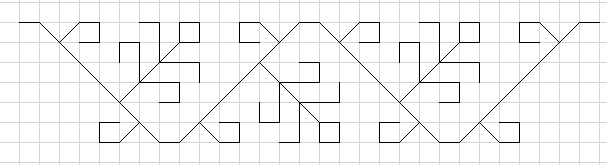
Another Blackwork Embroidery Pattern from an Italian Sampler

 Here is another blackwork embroidery pattern from the Italian sampler, circa 1600, on display at the Met.


Happy embroidering!

Saturday, October 10, 2020

Some Embroidery Patterns from Nicolo Zoppino's 1529 Book

Nicolo Zoppino was an Italian from Venice. His pattern book from 1529 was called Esemplario di Lavori. It's at the Met.

Photo credit - The Met


Here are a few patterns from the above book:


Here is something interesting... if you have followed my blog, then you may be thinking you have seen the above patterns before. And you would be correct! For example, the above double cross pattern is not only in Zoppino's pattern book, but it is also in Giovanni Antonio Tagliente's 1530 (Italian) book and Nicolas Bassee's New Modelbuch (German) from 1568.

The above acorn pattern is not only in Zoppino's book, but also in Hans Hofer's Formbuchlein (German) from 1545 and Nicolas Bassee's New Modelbuch (German) from 1568. 

The triple cross pattern above the acorn pattern is not only in Zoppino's 1529 book, but it is also in Hans Hofer's Formbuchlein (German) from 1545.


Friday, October 9, 2020

Some Embroidery Patterns from Giovanni Antonio Tagliente

Here are a couple of patterns based on the patterns found in Giovanni Antonio Tagliente's 1530 book called "Examples of Needlework", which is currently located at The Met. It was originally published in 1527. When searching for information on this book, look up "Opera Nuova". Tagliente was a Venetian calligrapher, author, and publisher.

More pages of the book, including patterns for embroidered letters, can be found here


Photo credit by The Met


Other popular pattern books from this time period include:

Essemplario di lavori by Nicolo Zoppino published in 1529

Ornamento Delle Belle & virtuose Donne by Matteo Pagano published in 1554

Schole-house for the Needle by Richard Shorleyker published in 1624 and 1632


My Latest Blackwork Embroidery Project

Here is what I have so far! The diamond pattern and the flower pattern both came from Jane Bostocke's sampler from 1598.

The linen fabric that I am using is not an even weave, so the pattern appears elongated. I am using twisted black silk thread for the embroidery. I counted every third hole per stitch on the linen fabric.

The fabric is mounted on to a slate frame, as seen here.


Watch as I embroider this project from beginning to end here.


Friday, September 18, 2020

More Blackwork Patterns from the Italian Sampler at the Met

These patterns are in addition to the patterns that I posted yesterday. These patterns are based off of the patterns found on the Italian sampler, circa 1600, on display at the Met. 

Some of the threads are missing on the sampler. So, I used my knowledge of blackwork and recreated the patterns to include the missing threads.


Thursday, September 17, 2020

Blackwork Patterns from an Italian Sampler

The Italian sampler below is from circa 1600. It is on display at the Met (Metropolitan Museum of Art). It features silk embroidery done in a double-running stitch, as well as white cutwork.
 
One of the many things that I love about blackwork embroidery (the geometric counted thread version) is this: when I looked at this sampler, I was able to find a couple of mistakes. However, I was also able to recreate the patterns, even though some of the thread is now missing. Also, thanks to the Met's website, the sampler can be enhanced enough to see that the stitches were done on every 5th hole of the linen fabric.


Embroidered sampler, Silk and linen on linen foundation, bobbin lace, Italian
 
 
The patterns below are from the top right corner of the sampler.