Monday, September 5, 2016

Pattern for the Collar to Edward VI's Shirt


Some believe that this is the portrait of Edward VI, the only legitimate son of Henry VIII of England. However, others attribute this painting to Henry Fitzroy, the illegitimate son of Henry VIII. 


Either way, here is the collar from this painting (pictured below), painted by Hans Holbein the Younger (circa 1535).


  (located in the Kunstmuseum Basel, the Basel Museum of Art, in Basel, Switzerland)

  
Here is my interpretation of the pattern based on the portrait:


My attempt at the pattern is pictured below.


Monday, August 15, 2016

Blackwork Embroidery Pattern

Here is the blackwork pattern found on the Portrait of a Lady by Bartolomeo Veneto, circa 1520s. This painting is at the Museum of Fine Arts in Houston and can be found online here.


https://upload.wikimedia.org/wikipedia/commons/3/31/Bartolomeo_Veneto_-_Portrait_of_a_Lady_-_Google_Art_Project.jpg

Thursday, July 14, 2016

More Paintings with Blackwork Embroidery


Sir George Cornwall (1543)


painting by Hans Holbein the Younger


https://theartstack.com/artist/hans-holbein-the-younger/sir-george-cornwall-prin


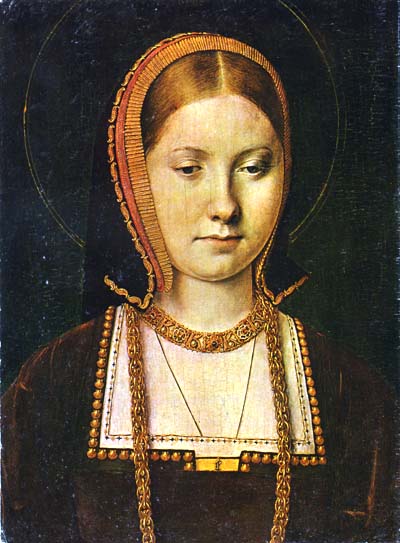
Catherine of Aragon (1520)


The sleeves!!


http://wwwjanetrobbinsaudio.blogspot.com/2015/05/the-art-of-dynasty.html


Portrait of a Lady, by Hans Holbein the Younger (circa 1543)


The inside collar of the partlet!


http://artintheblood.typepad.com/art_history_today/hans-holbein/


Click!


Portrait of Lady Dacre, by Hans Eworth
1540 Oil on wood, 74 x 58 cm  National Gallery of Canada, Ottawa

 http://www.wga.hu/frames-e.html?/html/e/eworth/l_dacre.html


File:Bess of Hardwick as Mistress St Lo.jpg

Bess of Hardwick (circa 1550s)

https://en.wikipedia.org/wiki/File:Bess_of_Hardwick_as_Mistress_St_Lo.jpg


preview

Portrait of a Lady (circa 1525)
by Bernardino Luini

http://www.nga.gov/content/ngaweb/Collection/art-object-page.44.html


File:Bartolomeo Veneto - Portrait of a Lady - Google Art Project.jpg

Portrait of a Lady (circa 1520)
by Bartolomeo Veneto
located in Museum of Fine Arts, Houston

https://commons.wikimedia.org/wiki/File:Bartolomeo_Veneto_-_Portrait_of_a_Lady_-_Google_Art_Project.jpg


Portrait of a Young Lady

Portrait of a Young Lady (circa 1520-1530)
by Bartolomeo Veneto

http://www.gallery.ca/en/see/collections/artwork.php?mkey=8920


File:Hans Holbein d. J. 033.jpg

Portrait of Lady Margaret Butts (circa 1543)
by Hans Holbein the Younger


http://www.gardnermuseum.org/collection/browse?filter=artist:3279


Click!

Portrait of the Artist's Sisters Playing Chess (circa 1555)
by Sofonisba Anguissola

http://www.wga.hu/frames-e.html?/html/a/anguisso/sofonisb/chess.html


SmockSmock

Smock with blackwork embroidery circa 1575-1585 at the Victoria & Albert Museum

http://collections.vam.ac.uk/item/O78732/smock-unknown/


Click!

Portrait of a Man (circa 1520-25)
by Girolamo Romanino

http://www.wga.hu/frames-e.html?/html/r/romanino/manportr.html


Click!


Double Portrait of Sir Thomas Godsalve and His Son John (circa 1528)
by Hans Holbein the Younger

http://www.wga.hu/frames-e.html?/html/h/holbein/hans_y/1528/7godsal.html


Click!

Portrait of Henry Howard, the Earl of Surrey (circa 1541-43)
by Hans Holbein the Younger

http://www.wga.hu/frames-e.html?/html/h/holbein/hans_y/1543/10surrey.html


Tuesday, July 12, 2016

More Paintings with Blackwork Embroidery Displayed

First, here is a miniature picture of Margaret Roper.


Portrait Miniature of Margaret Roper


Hans Holbein the Younger. Margaret More (1505–1544), Wife of William Roper, 1535–36. Vellum laid on card; diameter 1 3/4 in. (45 mm). The Metropolitan Museum of Art, New York, Rogers Fund, 1950
http://www.metmuseum.org/art/collection/search/436662


Next, here is a painting of a man in a red cap.


Hans Holbein the Younger (German, Augsburg 1497/98–1543 London). Date: 1532–35


Here is the Portrait of a Young Woman:


Workshop of Hans Holbein the Younger (German, Augsburg 1497/98–1543 London) Date: ca. 1540–45.


http://needleprint.blogspot.com/2012/08/anna-meyer-from-darmstadt-madonna-by.html


Here is a miniature of Jane Small:


https://en.wikipedia.org/wiki/Hans_Holbein_the_Younger


Hans Holbein the Elder (c. 1460 – 1524) Portrait of a Member of the Weiss Family of Augsburg 1522
http://bjws.blogspot.com/2015_10_13_archive.html


Catherine of Aragon (c. 1509)
http://www.uvm.edu/~hag/sca/tudor/aragon.jpg


Anne Boleyn
http://www.arthistorynews.com/articles/894_Anne_Boleyn_regains_her_head


Wednesday, May 4, 2016

Is Beeswax Historically Accurate to Use with Blackwork Embroidery?

This is a question that has been addressed to me a couple of times, such as during a Blackwork 101 class at RUM a couple of years ago and most recently while being judged at a regional A&S faire.


So far, I have not found any sufficient evidence to prove or disprove whether or not beeswax was actually used during the Tudor period for blackwork embroidery. Perhaps this is simply a matter of what the embroiderer prefers to do. Personally, I have never used beeswax before. Until my most recent blackwork project, I have never found a need to use beeswax.


For previous projects, I used Gutermann black silk thread bought at Joann Fabrics. Although this is technically 100% black silk thread, it's not historically accurate. So, for my latest project, a recommendation came from a Laurel to try Soie Ovale (unspun 100% black silk thread) from Hedgehog Handworks. The Gutermann thread is good for anyone who may show signs of being OCD and likes to have everything nice, neat, and orderly. The Soie Ovale is better if you are wanting something more historically accurate as well as something that is shinier and bolder. However, the problem that I have run into with the Soie Ovale is that the under-side is fraying and causing the tension in the pattern to loosen, plus the thread snags very easily.


Recently, I posted this inquiry to an embroidery group. It all seems to boil down to personal preference. Beeswax helps with regular hand-sewing to help keep the thread together without fuzzies or fraying, as well as strengthening the thread itself. One recommendation was to coat on the tail end only of the silk thread to prevent it from fraying. If beeswax is used on the silk thread, it will dull the shine. It was also recommended, if using beeswax, to obtain the beeswax from a beekeeper so that the bar is light and clean, without the flaky residue of bars sold in stores which may be inferior. Also, beeswax becomes harder with age, so use a fresh bar for better softness if using beeswax.


However, the overall preference in regards to using silk thread for blackwork embroidery was to not use beeswax. The beeswax reduces shine and may be more of a hindrance than a help. It may trap dirt and could potentially ruin the final project. Depending on the color of the beeswax, it may also change the color of the silk thread.