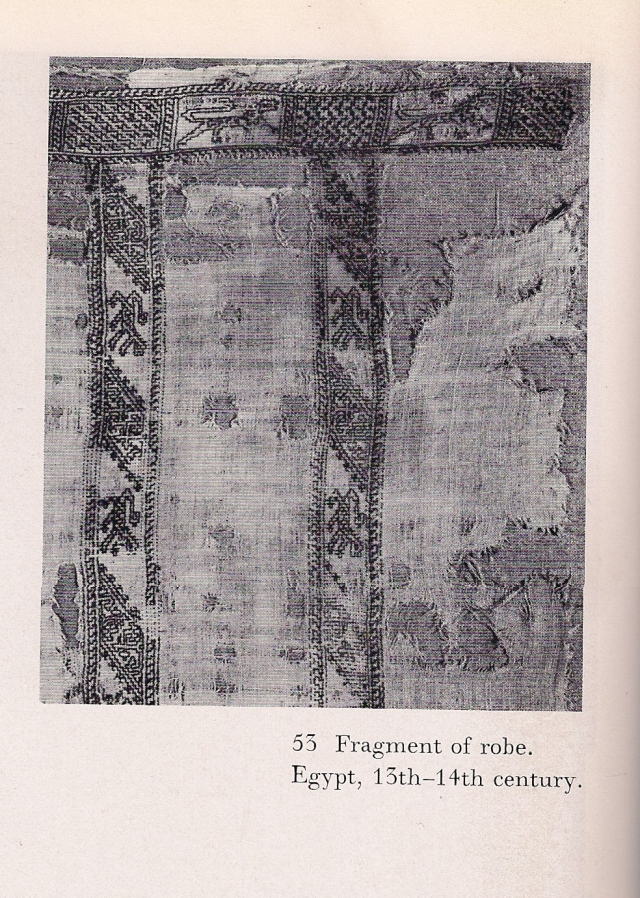
The original pattern was found on an Egyptian fragment of silk embroidery on linen at the Victoria & Albert Museum in London, England, circa 1250-1516.
For my interpretation of the pattern, I shortened up the lattice work. However, with the pattern, it can be easily be made wider. Here is my interpretation of the pattern:
Friday, December 13, 2019
Thursday, December 12, 2019
Egyptian Blackwork Embroidery Pattern
(Shimeon)
This "is a fragment of a robe, the actual size 56 by 42cm, in the Berlin Staatliches Museum. It is done in dark gray silk on linen in running and double-running stitch." (Shimeon)
For the blackwork embroidery pattern for the above picture, please visit here.
Works Cited:
Shimeon, Miriam bat. "A Complicated Mamluk Blackwork." 10 March 2012. https://awalimofstormhold.wordpress.com/2012/03/10/a-complicated-mamluk-blackwork/. 12 December 2019.
Blackwork Embroidery Patterns from Dollfus-Mieg & Co. 1890
Here are some of the patterns from the DMC Album fur Kreuzstichstickerei II, 1890. To view all of the pages of this album, please visit here.

Saturday, November 30, 2019
Blackwork Embroidery Patterns Inspired by Historical Paintings
The Portrait of a Young Woman was painted by a Netherlandish Painter circa 1535. If you go the provided link, the Met Museum allows you to zoom in close to study the embroidery pattern.
Below is my interpretation of the pattern found on the top of her collar.
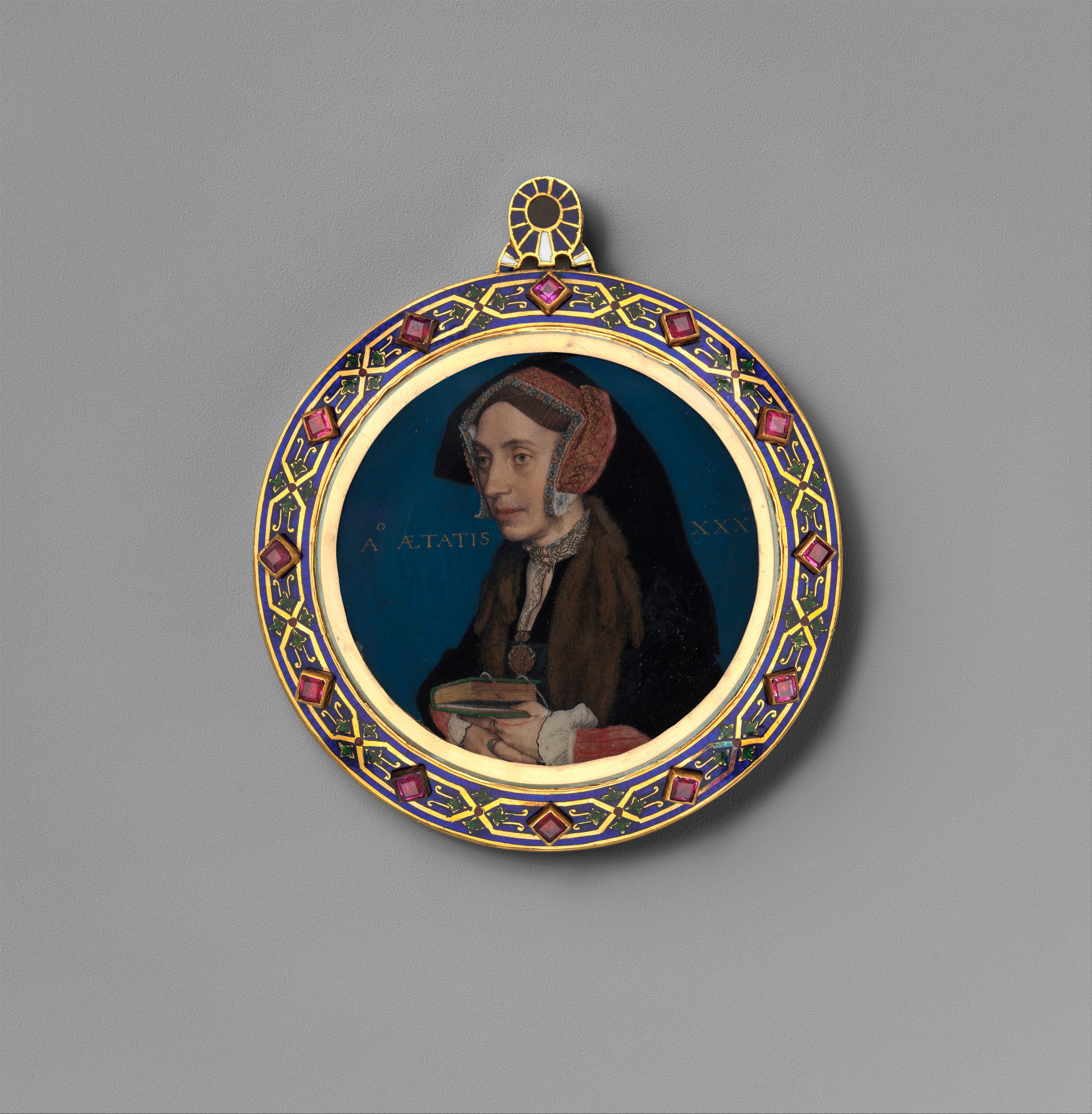
Margaret More, Wife of William Roper, was painted by Hans Holbein the Younger, circa 1535-1536. This portrait is available at the Met Museum (pictured below).
Below is my interpretation of the blackwork embroidery pattern found on her collar.
Click here for another portrait (Charles de Cosse, Count of Brissac, circa 1535, painted by Jean Clouet found at the Met Museum) with blackwork embroidery done in gold.
Click here for pages from a book of moresques by Francesco di Pellegrino, circa 1546 (available at the Met Museum), with patterns that could be used for blackwork embroidery.
Tuesday, November 26, 2019
Pattern from 17th Century Linen Handkerchief
Here is an embroidered handkerchief with double running stitch at the V&A Museum.
This linen handkerchief was made circa 1600-1630 in England. It is embroidered with silk thread and includes bobbin lace. "Thread count approx. 50 threads per cm. balanced plain weave. With five rows of small S-shaped motifs worked with pale green and yellow silk in Holbein stitch forms a border of 2 inches and edged with the lace. Gold thread at the four corners." (http://collections.vam.ac.uk/item/O11077/handkerchief-unknown/)
Below is my interpretation of the repeated pattern found on the above handkerchief.
This linen handkerchief was made circa 1600-1630 in England. It is embroidered with silk thread and includes bobbin lace. "Thread count approx. 50 threads per cm. balanced plain weave. With five rows of small S-shaped motifs worked with pale green and yellow silk in Holbein stitch forms a border of 2 inches and edged with the lace. Gold thread at the four corners." (http://collections.vam.ac.uk/item/O11077/handkerchief-unknown/)
Below is my interpretation of the repeated pattern found on the above handkerchief.
Embroidered Chalice Veil
In the SCA, I have seen people use fabric with embroidery and beading to cover their cups. This is practical, especially when outside at events, to help keep insects from flying in or around their drink. An example of a cover can be found here.
I decided that I wanted to try to make a cup cover. I also recently learned how to use my embroidery machine. So, I decided that I wanted to test out my embroidery machine to make a blackwork-inspired cup cover. The hem is hand-stitched. The beading is made up of glass beads and pearls. Please see below:
Although I have seen cup covers in the SCA, I also wanted to see how historically accurate these covers are. What I have found so far is that beeswax covered linen was used to create a medieval version of Tupperware. Check this out. Waxed linen covers have been seen in artwork since the 14th century.
But waxed linen covers are fairly stiff and (obviously) have beeswax on them. The covers that I have seen in the SCA are decorated with embroidery and/or beads, but do not have any beeswax on them. So, I tried to do an internet search to find out the history (if any) on these particular types of covers. Note: if you put in "cup cover" into a search engine, you will not find many websites related to this specific type of cover.
This cup cover is actually known as a chalice veil. If you go here, you can find some museum examples from the late 16th century.
I decided that I wanted to try to make a cup cover. I also recently learned how to use my embroidery machine. So, I decided that I wanted to test out my embroidery machine to make a blackwork-inspired cup cover. The hem is hand-stitched. The beading is made up of glass beads and pearls. Please see below:
Although I have seen cup covers in the SCA, I also wanted to see how historically accurate these covers are. What I have found so far is that beeswax covered linen was used to create a medieval version of Tupperware. Check this out. Waxed linen covers have been seen in artwork since the 14th century.
But waxed linen covers are fairly stiff and (obviously) have beeswax on them. The covers that I have seen in the SCA are decorated with embroidery and/or beads, but do not have any beeswax on them. So, I tried to do an internet search to find out the history (if any) on these particular types of covers. Note: if you put in "cup cover" into a search engine, you will not find many websites related to this specific type of cover.
This cup cover is actually known as a chalice veil. If you go here, you can find some museum examples from the late 16th century.
Saturday, November 23, 2019
Needlebook with Embroidery
The other day, I came across an embroidered needlebook online here. I was intrigued by this and wanted to try making one myself. Below are my pictures with descriptions to explain my experience making my first needlebook.
The outside cover is made of embroidered white linen. The inside is a red cotton fabric. The middle layer is red wool, to help stiffen the needlebook.
Here is what the completed needlebook looks like.
Lesson learned for the next time:
- Make the book smaller. This book measures 3.5 inches wide
by 4.5 inches long.
Here is a tutorial with step by step instructions on how to make
your own needlebook.
Needlebooks are not period (SCA wise). After briefly researching the history of needlebooks, the first needlebook on record appears to have been in the late 1800's (per the Nordic Needle). Many were produced from the 1920's to the 1950's (Needlebooks). So, although these are not historically accurate, I still like the concept of it for something to hold my needles in at events, rather than the modern plastic container that I have been using.
Above are some of the materials that I used. It's amazing to find another use for scrap fabric!
The two black ties are lucet cords that I braided.
Inside the needlebook, I created a small pocket on the right that opens towards the spine of the book, so that items will not fall out as easily.
Here is what the completed needlebook looks like.
Lesson learned for the next time:
- Make the book smaller. This book measures 3.5 inches wide
by 4.5 inches long.
Here is a tutorial with step by step instructions on how to make
your own needlebook.
Needlebooks are not period (SCA wise). After briefly researching the history of needlebooks, the first needlebook on record appears to have been in the late 1800's (per the Nordic Needle). Many were produced from the 1920's to the 1950's (Needlebooks). So, although these are not historically accurate, I still like the concept of it for something to hold my needles in at events, rather than the modern plastic container that I have been using.
Subscribe to:
Posts (Atom)