Monday, May 18, 2020

16th Century Blackwork Embroidery Inspired Patterns

Here is a 16th century blackwork embroidery inspired pattern based off the edge of the shift, from a painting at the Art Institute of Chicago. The Italian painting is called "Portrait of a Lady" by Michele Tosini, called Michele di Ridolfo circa 1550.


Here are more blackwork items at the Art Institute of Chicago:

- 16th century English doublet

- 16th century English coif

- 16th century English man's cap
     (This one can be zoomed in enough to count the embroidery stitches and see the stitches holding       the different sections together.)

- 1530 tin-glazed earthenware Italian dish
      (This is the first time that I have seen blackwork depicted on a historical plate.)


Here is a blackwork embroidery pattern based on a Flemish painting from 1544 called "Portrait of a Woman" at the Art Institute of Chicago.


Sunday, May 17, 2020

Suggestions for a More Historically Accurate Blackwork Embroidery Kit

So, you want to start doing blackwork embroidery? Or maybe you have done some blackwork embroidery before and want suggestions on how to make your next more project more historically accurate?

When I first learned blackwork embroidery, I used cross stitch canvas with embroidery floss and a scroll frame. I had scissors with a plastic handle. Then, I upgraded my fabric up to linen and began using a hoop frame. The use of silk thread was suggested to me. The list goes on.

So, in no specific order, here are some suggestions for improving your 16th century blackwork embroidery kit to be a little more historically accurate.

Slate frames are great for historical accuracy. Plus, these frames do not warp your fabric and mess with your tension like hoop frames do (although hoop frames are better for transportation purposes, in my opinion). Slate frames also do not move around as much as scroll frames do (in my experience, the tension usually loosened over time). To learn how to dress a slate frame, click here.


During the 16th century, needles appear to have been made from steel or iron. The main concern is to find a needle that is dainty with a small eye. The larger the eye, then the increased chance of the linen having random larger holes in it from the eye. One easy option for a needle would be DMC needles, which are nickel-plated stainless steel needles. I would recommend a needle size 24, 26, or 28, so that the needle does not warp the linen.

For holding your needles, you could make a needlebook, such as this one. However, the first needlebook on record appears to have been from the late 1800's. For a more historically accurate option, a wooden bobbin like the one at the Mary Rose Museum would be ideal. The wooden bobbin is hollow and has a wooden cork (or plug) on the one end.

Needle Set with Bobbin from Mary Rose Museum shop | Sewing ...

Silk thread is historically accurate for blackwork embroidery. Based on my previous experiences, I would recommend using twisted silk thread instead of untwisted silk thread. For either type of thread, look for soie ovale (untwisted) or soie perlee (twisted). Especially for the untwisted silk thread, I highly recommend using beeswax for the ends of the threads to help prevent fraying.

Beeswax has been around for centuries. It was used for a variety of things, such as candle-making and soaked in linen to create a Tupperware-type seal on bowls. It has also been used to prevent threads from fraying. For more information about whether to use beeswax or not, please visit here.

Linen was the most common fabric that had blackwork embroidery on it during the 16th century. Other fabrics were also used, but not nearly as much. The linen fabric does not need to be an even-weave fabric. Bleached white was the color of linen used in western Europe. In previous centuries, an unbleached white was common in the Egyptian (Moorish) territories.

Snips or scissors are also good to have in your embroidery kit. Check out this link for more information on the different styles of scissors through history.

Normally, I do not find the need to have a thimble when I am doing blackwork embroidery. However, if you would like to have a thimble handy, then look at this link for more information on the different types of thimbles over the centuries.

1st row: open topped thimbles and thumbrings, from left to right ...

For containing my embroidery kit, I use a simple basket with a lid (flap) on either side of the handle. This is just one suggestion of how to carry your embroidery kit. My main recommendation for being more historically accurate would be to not carry your items around in a plastic grocery bag (which was my first embroidery bag).

If you have any questions on how to improve your embroidery kit for a more historically accurate blackwork project, please ask.

Tuesday, May 5, 2020

Suggestions on How to End Your Threads Invisibly

Check this link out for suggestions on how to end your threads invisibly.

If you knot your ends, the pattern won't be completely reversible and you risk having lumps show through your fabric.

Weaving the tails into the backside of your embroidery is the best option. On the link above, there are pictures provided that demonstrate recommendations on what to do or not do.

Thursday, April 23, 2020

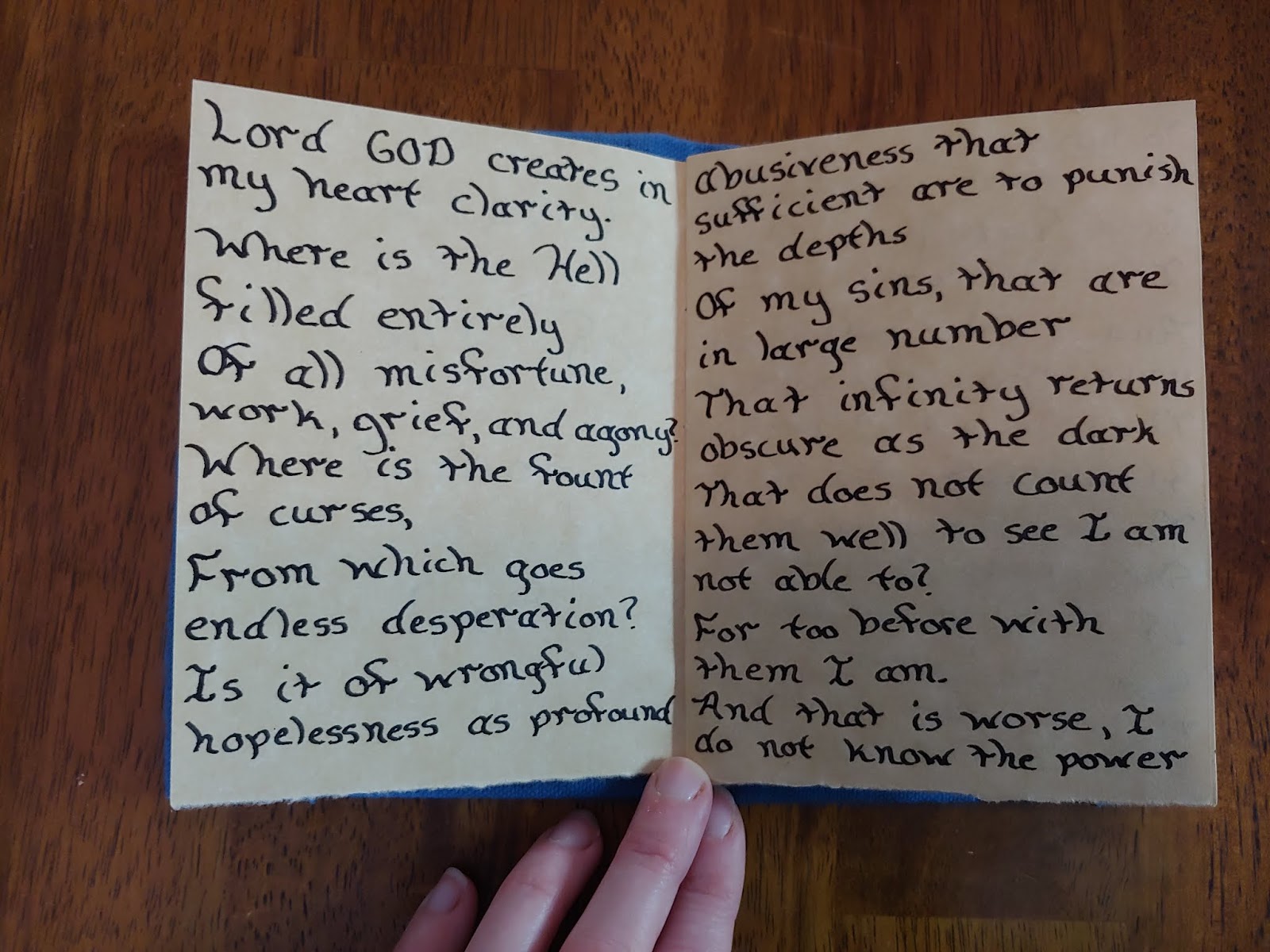
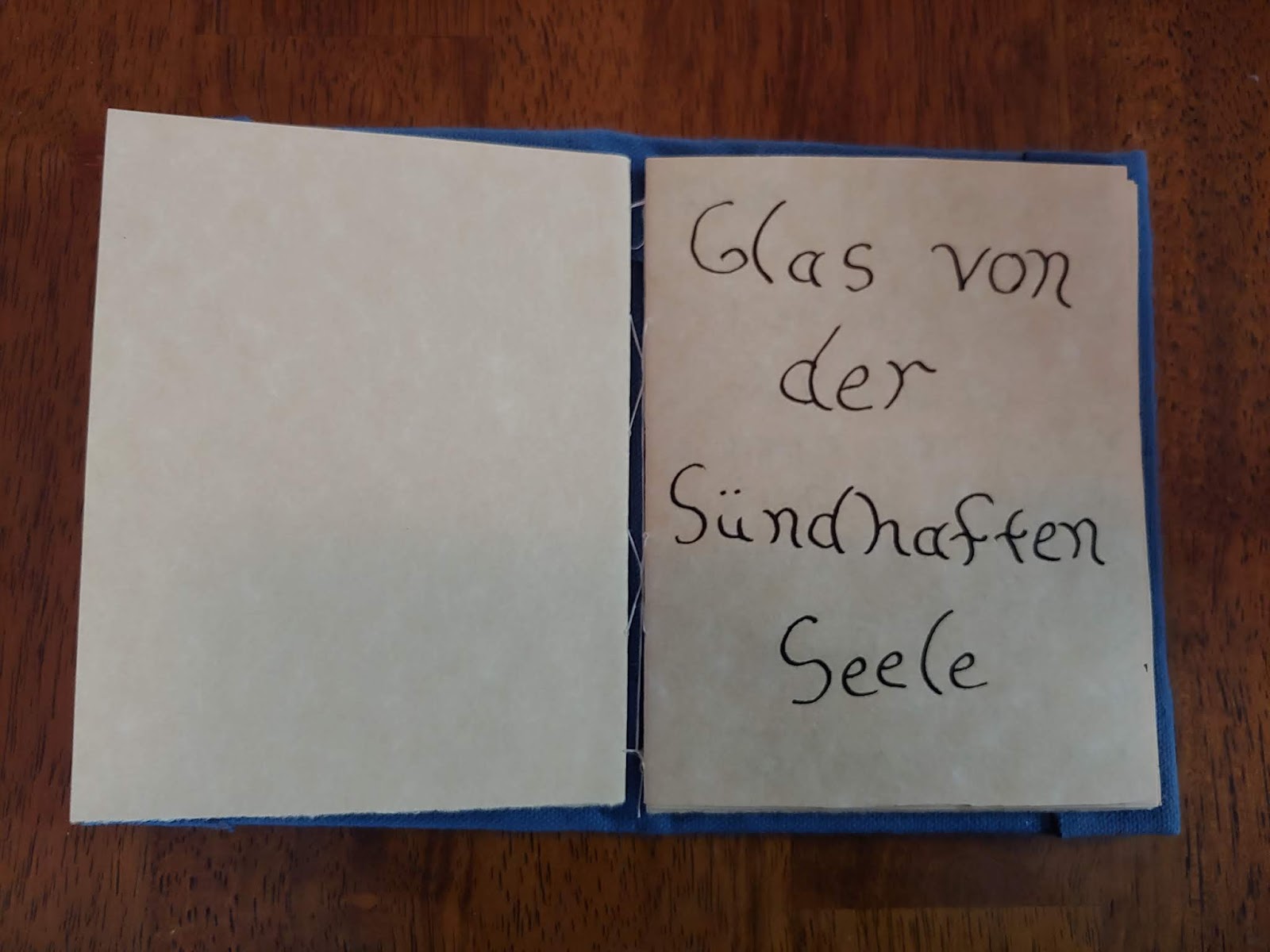
Embroidered Book with Translation from the Glasse of the Synneful Soul

Reversible cross-stitch existed during Elizabethan times. An example of this would the embroidered 16th century shirt found here.

A previous project of mine was inspired by the first book given to Catherine Parr (6th wife of Henry VIII) in 1544 by Princess Elizabeth (later Elizabeth I) as a New Year's gift. This book had an embroidered cover. Inside the book were the translated works of Elizabeth. She had translated the Glasse of the Synneful Soul (a poem written by Marguerite of Navarre) from French into English. This book is now owned by the Bodleian Library.


Later, in 1545, Elizabeth gifted another book. This gift was given to her father, King Henry VIII, as a New Year's gift. This book also had an embroidered cover. Inside this book were English prayers that Elizabeth had translated into French, Latin, and Italian.


These two books had been my inspirations for my project. I embroidered the book cover with reversible cross stitch for the square. Then, I did chain stitch embroidery for the initials. For this project, I began learning about bookbinding. I also began to learn about calligraphy. I translated the first 3 paragraphs of Le Miroir de l'ame pecheresse (the Glasse of the Synneful Soul) from French into Spanish, German, and English. 

Below are pictures from my book.


 English:


 German:


 Spanish:


 French:


Virtual Class for Introduction to Blackwork Embroidery

Recently, I taught an online class for RUM (Royal University of the Midrealm). This class was an Introduction to Blackwork Embroidery. I briefly discussed the history of blackwork embroidery, along with teaching the basics of how to do this historical embroidery.

Please check out the class here


Sunday, March 29, 2020

10th-15th Century Egyptian Blackwork Pattern

There is an Egyptian textile fragment at the Ashmolean Museum with interlacing chevrons and Maltese crosses circa 10th-15th century, which can be seen here.

Here is the fragment:
(Ashmolean Museum)


And here is my interpretation of part of the embroidery pattern:

Friday, March 27, 2020

More Egyptian Embroidery Patterns from the Mamluk Time Period

Here is the original embroidered linen, currently located at the V&A Museum.

The museum describes this textile piece as "silk on linen, 1250-1516, Egyptian; Mamluk. El-Azam. Tree and bird motifs". 


At the very bottom of the linen is a small embroidered pattern. Here is my interpretation of that pattern:


Then, there appears to be chicken-like birds on this linen. Here is my interpretation of one of the birds:


Underneath the birds, there is a diamond pattern. Here is my interpretation of that pattern: